
The Two-Minute Paradox
Author: Pranav Kumar

A few weeks ago, I was facilitating a workshop for marketing managers at a leading pharma company in Ahmedabad. These were seasoned professionals managing chronic therapy brands—products that patients depend on for years, sometimes lifetimes. When I asked them about their biggest challenge, the room fell silent before a senior manager spoke: “How do we build lasting trust when our MRs get less than two minutes with a doctor?”
The same week, over dinner in Bengaluru, my friend Dr. Pradeep Kumar—Medical Director of a multi-speciality hospital—offered the physician’s mirror image of this frustration: “Why should I waste my precious time listening to so many medical reps talking the same thing for a similar set of drugs?”
There it was. The eternal brand-building paradox, served on two plates. One desperate for more time to communicate; the other wondering why communication happens at all.

Figure 1: The Two-Minute Paradox — Two scarcities, one resolution
This essay is not about solving the time problem. It is about dissolving it. Because the question was never “How do we fit more into two minutes?” The question always was: “How do we become the one worth listening to?”
Beyond Belief: The Architecture of Trust
In Hindi/Urdu, we distinguish between yakeen (belief) and vishwas (trust). Belief is cognitive—reasoned, persuaded, data-driven. Trust is experiential—felt, accumulated, earned. You can create belief in two minutes with the right clinical evidence. Trust takes two years of consistent presence.
India’s branded generics market—with over 70,000 brands competing for physician mindshare with often-identical molecules—has long operated on the belief model. More data, faster detailing, cleverer visual aids. But here is what three decades in this industry have taught me: when the molecule cannot differentiate, only the experience can.
Dr. Pradeep is not tired of information. He is exhausted by the absence of insight. The MRs he remembers—and there are a few—are not the ones who talked fastest. They are the ones who listened first.
Playbook Principle #1: Design for dialogue, not detailing. The two minutes are not for downloading—they are for connecting.
The Three Pillars of Forever Trust
In my work as a Customer Experience designer, I have observed that eternal brands—the ones physicians prescribe reflexively, the ones patients ask for by name—are built on three pillars: Empathy, Insight, and Consistency. See, Serve, Sustain.
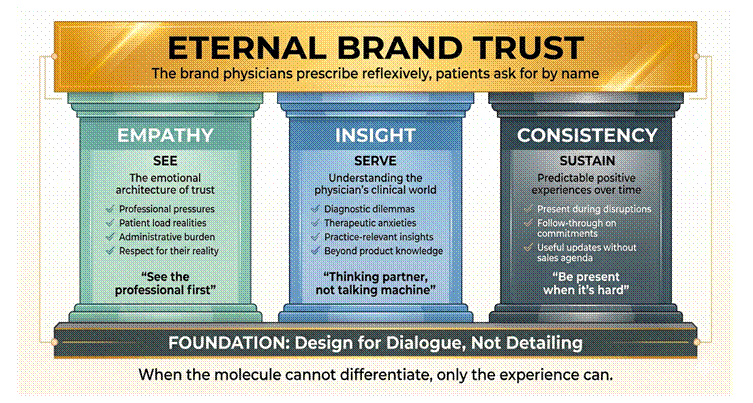
Figure 2: The Three Pillars of Forever Trust — See, Serve, Sustain
Empathy (See): This is the emotional architecture of trust—seeing the professional behind the prescription pad. The physician navigating impossible patient loads, the specialist managing complex treatment decisions, the GP balancing clinical care with administrative burden. When we design brand experiences that respect the physician’s reality, not just target their behaviour, we cross from transaction to relationship. Empathy is the starting point because you cannot bring relevant insights without first understanding their world.
Playbook Principle #2: See the professional’s reality first; the prescriber will follow.
Insight (Serve): Beyond product knowledge lies a deeper value—understanding the physician’s clinical world. Their diagnostic dilemmas, their therapeutic anxieties, their time pressures. The shift from “detailing” to “dialoguing” begins when we bring insights that genuinely help their practice, not just information that serves our sales cycle. Empathy tells us what matters; insight lets us serve it.
Playbook Principle #3: Become the physician’s thinking partner, not their talking machine.
Consistency (Sustain): Trust is the sum of predictable positive experiences over time. The MR who proactively communicates during a supply disruption, who follows through on every commitment made, who provides useful updates even when there is nothing new to sell—this is the one who builds lasting trust. Brand managers, ask yourself: Is your field force trained for presence, or only for persuasion?
Playbook Principle #4: Be present when it is hard, not just when it is convenient.
AI: The Amplifier, Not the Architect
We stand at an inflection point. Generative AI promises hyper-personalisation, predictive detailing, automated follow-ups. The temptation is seductive: let algorithms handle the knowing, and humans can handle… what exactly?
Here is my conviction: AI can help us understand deeper, but only humans can connect better. The technology should serve the relationship, not substitute it. Use AI to know that Dr. Sharma’s practice focuses heavily on renal complications and she values outcome data over mechanism slides. Then let the human representative have a genuinely relevant conversation that respects her expertise and time.
Playbook Principle #5: Let AI do the knowing. Let humans do the connecting.
Building for Successors: The Legacy Mindset
As we commemorate the 10th World Pharma Brand Managers Day, honouring the legacies of Prof. Chitta Mitra and Prof. Tarun Gupta, I am reminded that these stalwarts did not build brands for quarterly results. They built philosophies that outlived campaigns, relationships that transcended transactions, principles that guide us still.
The eternal brand manager thinks like a trustee, not an owner. Every interaction either enriches or depletes the trust reservoir for those who come after. The MR territory you inherit carries the cumulative weight of every promise kept and broken by your predecessors. The brand you steward will be judged not by this quarter’s numbers, but by whether physicians still trust it a decade hence.
Playbook Principle #6: Build for your successor, not just your incentive.
A Word to Young Brand Builders
To those inheriting this craft: You are not in the business of selling molecules. You are in the architecture of trust—designing experiences that heal, relationships that endure, brands that become synonymous with reliability and care.
A forever trusted brand is like a banyan tree: its roots go deep into human truth, and its branches shelter generations. The two minutes will never be enough for telling. They will always be enough for listening. And in that listening—that genuine, present, human attention—lies the human side of eternal brand building.